Stress & sleep
Ashwagandha for Students: What Science Says About Stress and Sleep
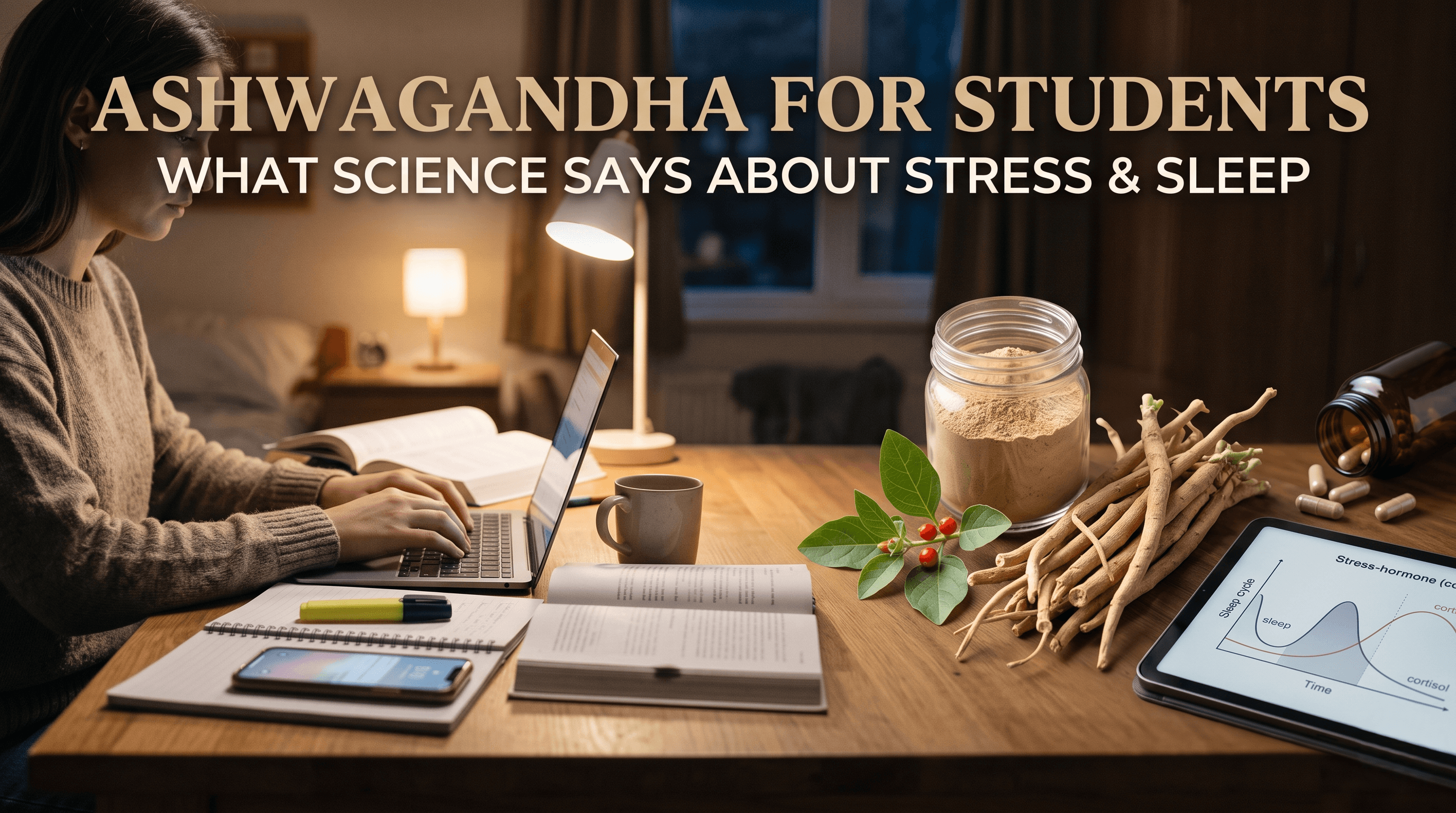
Exams, deadlines and demanding study schedules can make it difficult to switch off. Ashwagandha (Withania somnifera), a herb used in Ayurveda, has attracted scientific interest for its potential to support stress management and sleep. For adult students, it may be an option to consider alongside healthy routines—but the evidence needs careful interpretation.
What is ashwagandha?
Ashwagandha is often described as an “adaptogen”: a term used for substances proposed to help the body adapt to stress. Its extracts contain withanolides and other plant compounds. Root powder, root extracts and root-and-leaf extracts differ in composition, so results from one preparation cannot automatically be applied to every supplement.[5]
What do clinical studies show?
Reduced perceived stress in adults
In a randomized, double-blind, placebo-controlled trial, 64 adults with chronic stress received either ashwagandha root extract or placebo for 60 days. The extract group took 300 mg twice daily and showed greater improvements in stress-assessment scores and a greater reduction in serum cortisol than the placebo group.[1]
A second eight-week trial involving 60 stressed adults studied root extract at 250 mg or 600 mg daily. Researchers reported improvements in perceived stress, with the 600 mg group also showing improvements in anxiety measures and sleep quality.[2]
These findings support the potential of particular ashwagandha extracts for stress management in adults.
What about students specifically?
A 2022 double-blind, placebo-controlled study enrolled 60 healthy college students and investigated 700 mg daily of a full-spectrum root extract for 30 days. The overall group-by-time analysis for stress and sleep was not statistically significant. A follow-up analysis, adjusting for initial sleep scores, found better final restorative sleep scores in the ashwagandha group.[3]
This is encouraging preliminary evidence for sleep support. It also does provide clear proof that ashwagandha reduces examination stress. Still larger, longer studies in students are needed.
Sleep support in adult research
An eight-week placebo-controlled trial in 80 adults, including healthy volunteers and people with insomnia, investigated ashwagandha root extract and reported improvements in sleep outcomes, with greater effects in participants with insomnia.[4]
For a student considering supplementation, this suggests a possible role in a broader sleep routine. It does not mean ashwagandha can compensate for late-night studying or insufficient sleep.
How might it work?
Some adult trials have found reductions in cortisol, a hormone involved in the stress response.[1,2] Researchers also propose effects on stress-response pathways and signalling involved in relaxation. These mechanisms remain established in humans also. Although, change in cortisol alone does not prove improved mental health or academic performance.
What should adult students expect?
Ashwagandha may help some adults manage perceived stress or improve sleep, depending on the extract and individual circumstances. Ashwagandha KSM 66 is the best form of ashwagandha available in market. Most relevant adult trials assessed its calming effect after regular use over several weeks; though it should not be presented as an instant calming solution.[1,2,4]
Start with practical foundations: a consistent sleep schedule, realistic study blocks, regular movement, balanced meals and manageable caffeine intake. Persistent anxiety or sleep difficulties deserve professional assessment.
Explore your stress-support options
An informed wellness routine begins with understanding the evidence. Explore our ashwagandha product page to review the ingredient, extract specifications, usage directions and precautions—and decide with a qualified healthcare professional whether it suits your needs.
Nutraceutical. Not for medicinal use. This article is educational. The product is not intended to diagnose, treat, cure or prevent disease. Individual results may vary.
Scientific references
1. Chandrasekhar K, Kapoor J, Anishetty S. A prospective, randomized double-blind, placebo-controlled study of safety and efficacy of a high-concentration full-spectrum extract of ashwagandha root in reducing stress and anxiety in adults. Indian Journal of Psychological Medicine. 2012;34(3):255–262. doi:10.4103/0253-7176.106022.
2. Salve J, Pate S, Debnath K, Langade D. Adaptogenic and anxiolytic effects of ashwagandha root extract in healthy adults: a double-blind, randomized, placebo-controlled clinical study. Cureus. 2019;11(12):e6466. PubMed.
3. O’Connor J, Lindsay K, Baker C, Kirby J, Hutchins A, Harris M. The impact of ashwagandha on stress, sleep quality, and food cravings in college students: quantitative analysis of a double-blind randomized control trial. Journal of Medicinal Food. 2022;25(12):1086–1094. doi:10.1089/jmf.2022.0040. See also the 2023 correction, clarifying that higher restorative sleep scores indicate better sleep.
4. Langade D, Thakare V, Kanchi S, Kelgane S. Clinical evaluation of the pharmacological impact of ashwagandha root extract on sleep in healthy volunteers and insomnia patients: a double-blind, randomized, parallel-group, placebo-controlled study. Journal of Ethnopharmacology. 2021;264:113276. doi:10.1016/j.jep.2020.113276.
5. National Institutes of Health, Office of Dietary Supplements. Ashwagandha: Is it helpful for stress, anxiety, or sleep? Health Professional Fact Sheet. Accessed 4 October 2026